I have been using AI since ChatGPT’s initial public release in 2022. This year, 2026, I really dove into Codex. But so many other options have emerged over the last 1–2 years that it can be hard to figure out what should be used for what.
Besides the well-known ChatGPT, Claude, Gemini, and Grok conversational chatbots, there are also ChatGPT Work, Codex, Claude Code, Claude Cowork, Grok Build, Gemini CLI, and the list keeps growing.
So which one should you use?
At a high level, most of these products fall into a few broad categories:
| Type | Examples | Best for |
|---|---|---|
| Web chatbots | ChatGPT, Claude, Gemini, Grok | Asking questions, research, writing, brainstorming, and conversation |
| Technical agents | Codex, Claude Code, Gemini CLI | Coding, software projects, and other technical work |
| General-purpose agents | ChatGPT Work, Claude Cowork | Multi-step work involving documents, files, apps, and websites |
For most everyday questions and conversations, a web chatbot is the simplest choice.
If you want AI to actually work through a technical task—editing code, running commands, or working with a software project—a technical agent is usually a better fit.
And if you want AI to carry out broader multi-step work involving documents, applications, websites, and other tools, a general-purpose agent may make more sense.
But why do these products behave so differently, even when they're powered by the same AI models?
Models: The Intelligence Underneath
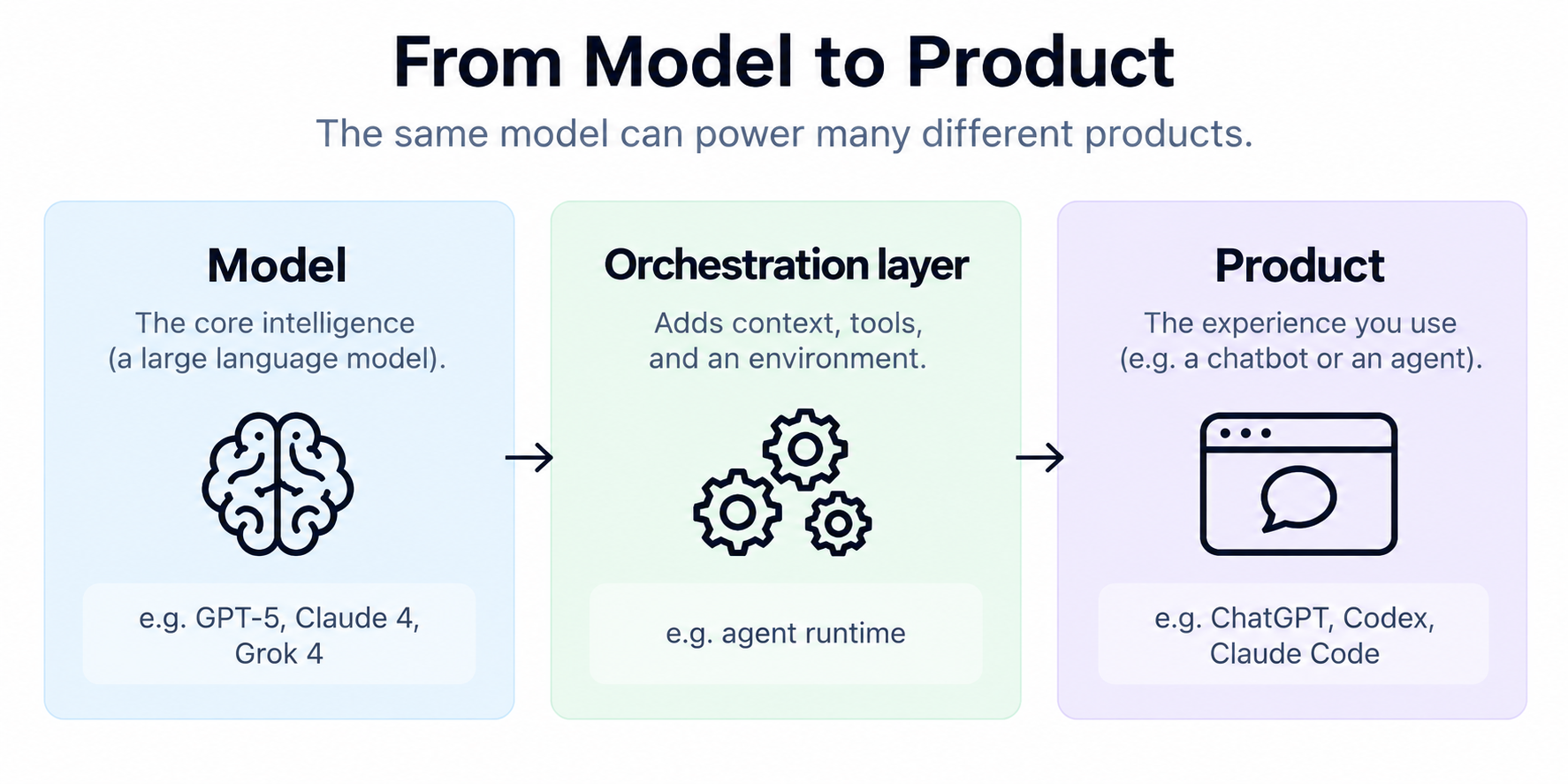
At the heart of these products is an AI model.
These are the names that tend to get most of the attention in AI announcements and headlines: GPT-6 Astra, Claude Opus 4, Grok 4.6, etc.
The model is typically a large language model (LLM), a type of neural network trained to process and generate language, including text and code.
Orchestration Layer
Between the model and the product you interact with sits an orchestration layer. It manages things like context, instructions, tool use, and how the model interacts with the rest of the system.
For example, the orchestration layer might determine what conversation history to give the model, which tools it can use, and what happens when it asks to search the web or modify a file.
In a web chatbot like ChatGPT or Claude, this orchestration can allow the model to search the web, use connected tools, work with uploaded files, and draw on the context of your conversation. But the interaction is generally driven by you, one turn at a time.
Agentic products such as Codex and Claude Code go further. You can give them a goal, and they can repeatedly reason about what to do, take actions, observe what happened, and decide what to do next.
In agentic systems, this orchestration layer is often called an agent harness or agent runtime.
Chatbots vs. Agents
This leads to one of the most useful distinctions between today's AI products: chatbots versus agents.
There are two main differences.
First, agents are typically given an environment they can act upon. Rather than primarily interacting with you through a chat interface in your browser, an agent is given a workspace—such as your computer or a dedicated cloud environment—where it can actually do things. E.g. creating and modifying files, running commands, interacting with applications, browsing websites, or otherwise changing the state of their environment.
Second, agents can iterate autonomously. Instead of simply producing a response and waiting for you, an agent can take an action, observe the result, and use that information to determine its next step.
A chatbot might tell you what to change in a document. An agent can make the changes itself, review the result, decide what still needs improvement, and keep working until the task is complete.
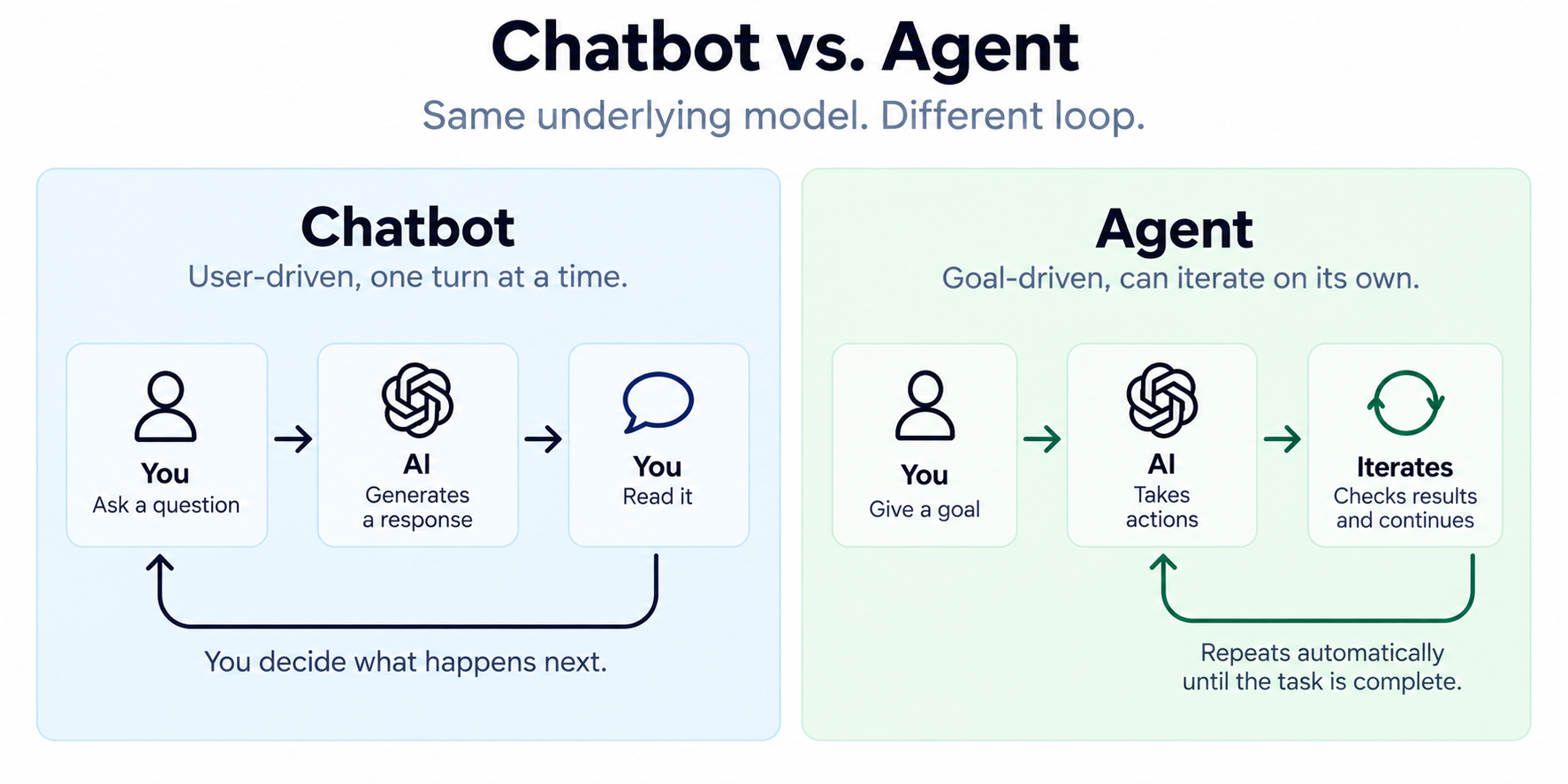
This orchestration layer is why using ChatGPT can feel so different from using Codex, even when they use the same underlying models. The model may provide the intelligence, but the orchestration around it determines much of what that intelligence can actually do.
So, Which AI Should You Use?
The boundaries between these categories are getting blurrier as AI products gain new capabilities. Chatbots can increasingly use tools and take actions, while agents are becoming easier for nontechnical users to use.
But the basic distinction is still useful.
If you want to ask, discuss, research, write, or brainstorm, start with a chatbot.
If you want AI to work within a technical environment and carry out a task, use a technical agent.
And if you want AI to work through a broader multi-step task involving files, applications, or websites, consider a general-purpose agent.
The important thing isn't just which company makes an AI product or even which model it uses. It's what the product is designed to let that model do.
Once you start thinking in terms of models, orchestration, and products, the increasingly crowded AI landscape becomes easier to navigate.